From 73,857 Long COVID records to one plausible treatment lane
I built a pipeline that keeps every claim connected to its source. This is the interim output from one lane it surfaced: supervised rehabilitation and breathing-focused programmes.
First: what is Long COVID?
Long COVID—also called post-COVID-19 condition—is the continuation or development of symptoms after the initial SARS-CoV-2 infection. The World Health Organization’s clinical definition usually places onset around three months after infection, with symptoms lasting at least two months and not explained by another diagnosis.
Definition source: WHO post-COVID-19 condition questions and answers.
What work is being done?
Because Long COVID is heterogeneous and its mechanisms are still being resolved, the research field is not pursuing one universal treatment. It is testing several different kinds of intervention that answer different questions.
These are research lanes, not a list of proven treatments. A biomarker change is not automatically a patient benefit, improvement inside one uncontrolled group can reflect natural recovery, and an acute antiviral finding cannot be relabelled as treatment for established Long COVID.
What our research pipeline found
We built a broad evidence map rather than starting with rehabilitation. The project was designed around a simple rule: a summary is only useful if the reader can travel back to the paper, the exact supporting span, and the processing version that produced it.
At the checkpoint used here, 1,105 papers had passed the exact-span support gate, including 81 PubMed-indexed randomized controlled trials. That gate checks whether an extracted statement is supported. It is not a formal risk-of-bias or GRADE judgment.
Across that incomplete map, supervised rehabilitation and breathing-focused programmes were the most recurrent positive treatment family. That did not make rehabilitation “the answer.” It made it a useful cluster to investigate more deeply: which programmes were tested, what their control groups received, which outcomes moved, and how confident a patient should be.
Why did clinicians try rehabilitation in the first place?
The idea came before strong Long COVID trial evidence. Clinicians were seeing people—especially after hospitalization—with a familiar rehabilitation problem: breathlessness, fatigue, muscle weakness, reduced physical capacity, distress, and difficulty returning to ordinary activities. At the same time, drug treatments for the established condition were limited and the underlying biology was still uncertain.
Researchers therefore borrowed a care model, not a claim about the cause. Pulmonary rehabilitation already combined tailored activity, education, and psychological support for illnesses such as COPD. Experience after SARS and critical illness offered another precedent. Because fatigue and post-exertional symptoms overlapped with ME/CFS, the REGAIN team also reviewed that literature and explicitly adapted the programme away from automatic, linear exercise progression.
Primary design sources: REGAIN intervention development and the REGAIN randomized trial.
This did not assume that Long COVID was simply deconditioning or “damaged muscles.” Weakness and loss of capacity after severe illness could be modifiable in some patients, but rehabilitation was framed as an adjunct for consequences that might be treatable while disease mechanisms remained unresolved. That distinction matters for people with biological exercise intolerance or post-exertional malaise.
The interim evidence map later found repeated controlled signals around supervised rehabilitation and breathing-focused programmes. Their common target was not viral clearance or cure. It was the downstream burden patients feel: reduced capacity, breathlessness, fatigue, pain, fear of activity, disrupted routines, and lower quality of life.
Why a programme might help
- rebuild cardiovascular and peripheral-muscle capacity after illness and inactivity;
- train inspiratory muscles and breathing control where respiratory limitations are present;
- use pacing, supervision, and feedback to find a tolerable activity dose;
- support sleep, fatigue, fear avoidance, setbacks, and confidence in daily activities; and
- provide repeated practitioner and peer contact instead of one-off advice.
What this theory does not explain away
- Long COVID is heterogeneous and can involve autonomic, vascular, immune, metabolic, or oxygen-extraction abnormalities;
- muscle symptoms are not necessarily simple deconditioning;
- post-exertional malaise or symptom exacerbation can make generic progression unsafe; and
- a positive programme does not prove which component caused the benefit.
What the six selected trials actually did
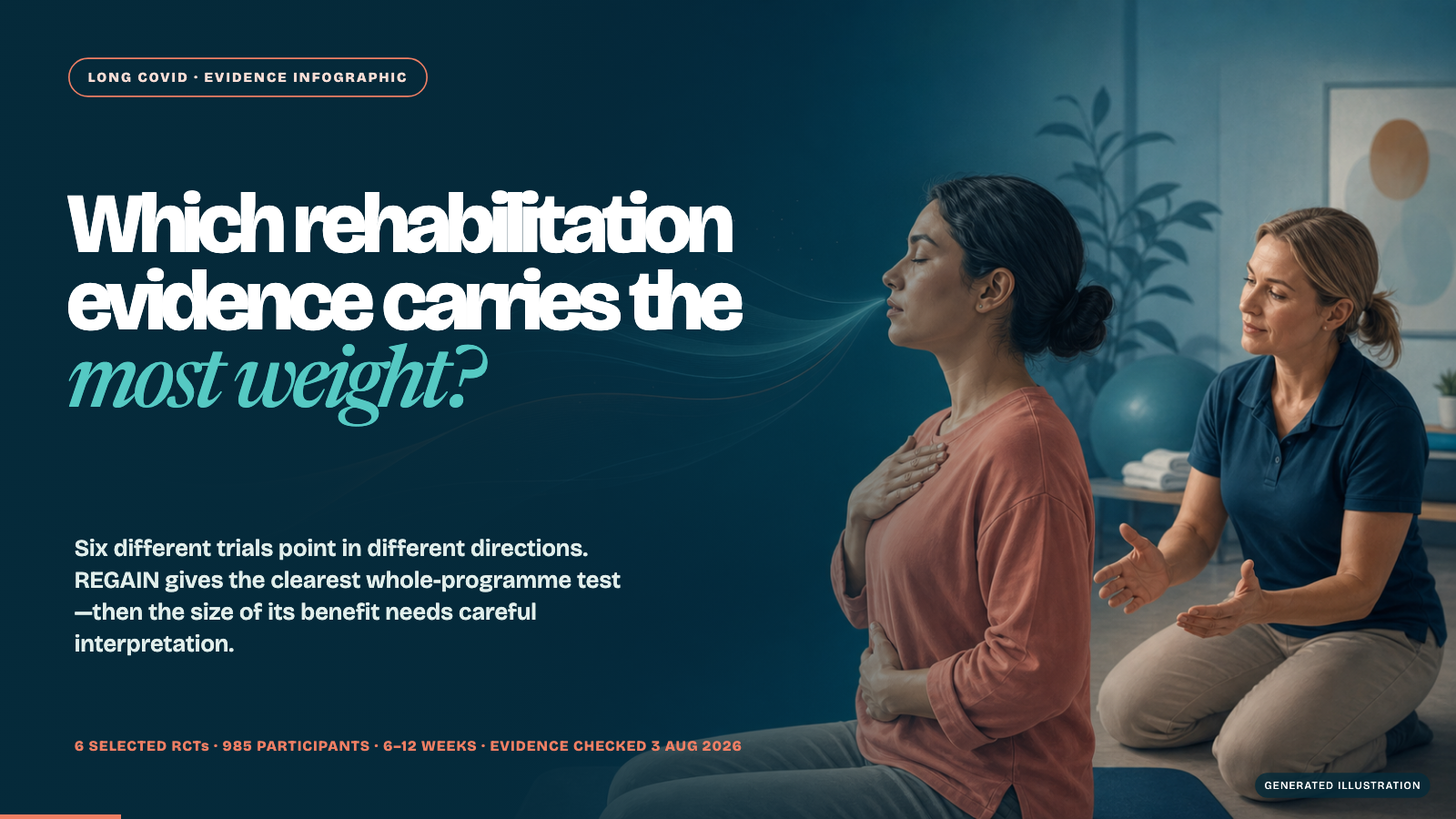
Together, these six randomized trials enrolled 985 people. That total is descriptive only: the populations, controls, outcomes, and scales differ, so the results should not be pooled by eye.
| Trial | People | Intervention versus control | Main reading | Paper |
|---|---|---|---|---|
| REGAIN | 585 | 8-week online supervised exercise + behavioural support versus a consultation, booklet, and general advice | Small quality-of-life advantage; strongest whole-programme test | PMID 38325873 |
| ENO Breathe | 150 | 6-week online breathing, singing, and wellbeing programme versus usual care | Mental HRQoL and some breathlessness signals; physical HRQoL inconclusive | PMID 35489367 |
| Respiratory muscle training | 88 | Inspiratory or combined respiratory training versus matched sham arms | Some respiratory strength and quality-of-life effects; exercise tolerance not consistently improved | PMID 36191860 |
| PuRe-COVID | 76 | 36 individualized primary-care pulmonary-rehabilitation sessions over 12 weeks versus no rehabilitation | +39 m adjusted 6-minute walk change; fatigue and dyspnoea also favoured rehabilitation | PMID 41253410 |
| Breathing + mobility | 46 | 4-week home breathing and chest-mobility exercise versus active lifestyle advice | Improved cardiopulmonary exercise measures; quality-of-life difference not established | PMID 39425012 |
| Inspiratory strength | 40 | 8-week inspiratory-muscle strength training versus breathing control | Function, dyspnoea, fatigue, and respiratory-performance signals in a narrow pulmonary subgroup | PMID 41906071 |
Why REGAIN is the clearest anchor
REGAIN is not proof of the “best” rehabilitation. It is the most decision-informative trial in this selected set because it was large, multicentre, randomized, compared the programme with active usual care, used a prespecified patient-reported primary outcome, and followed people to 12 months.
The added 8-week package
- one-hour individual online assessment;
- eight weekly live supervised group exercise sessions;
- six one-hour group behavioural-support sessions;
- equipment-free activities tailored for fitness, strength, balance, fatigue, and daily function;
- workbook and recorded exercise, breathing, yoga, Pilates, and mindfulness resources.
An active comparison—not nothing
- one 30-minute individual online consultation;
- the NHS “Your COVID Recovery” style booklet;
- discussion of symptoms and recovery;
- general advice for self-directed physical activity;
- no structured activity plan or specific psychological technique.
The psychological sessions covered motivation, fear avoidance, pacing, emotions and setbacks, sleep and fatigue, and stress and anxiety. Participants could share experiences in groups of up to 12. Mindfulness was available in the resource library, but the trial did not isolate meditation—or any other component—as the active ingredient.
What happened inside the group exercise?
This was closer to a remotely supervised rehabilitation class than a follow-along fitness video. Participants stayed with the same group across eight weeks. The participant information sheet described groups of 6–10 people and a live class of about 40 minutes; the development paper described up to 30 minutes of light-to-moderate exercise within a session. Warm-up, cool-down, checks and pauses explain why total class time and active exercise time were not identical.
Check and set up
Brief health questions, camera view, space and chair checked; the practitioner already had an agreed starting plan.
Warm-up and mobility
Gentle movement prepared joints, coordination and balance before the circuit.
Modifiable circuit
Usually 7–8 exercises for 2–3 rounds, with active recovery, rest and water breaks between efforts.
Cool-down and review
Participants repeated brief health questions and practitioners monitored problems during and after exercise.
The paper’s worked example: intermediate session 5
This example used two circuits. Each exercise was scheduled for 45 seconds, followed by 30 seconds of active recovery such as marching, side-steps or heel digs.
- Squat plus one-arm reach
- Very slow lateral arm raise
- Side lunge with slow biceps curl
- High pull from knees toward chest
- Wide-stance cross-body knee or toe reach
- Standing overhead press
- Seated leg lift over an object
Ways the template could be made easier
Use a chair, reduce the range of movement, take a shallower lunge, alternate arms, hold support, or perform an exercise seated.
Ways it could be made harder
Increase the range of movement, pause at the top, or add optional household resistance such as water bottles or tins.
Important: this was one published intermediate template—not the routine every participant performed. Practitioners could swap exercises and adjust the session for the group.
The design group proposed light-to-moderate activity after familiarisation, with breathlessness and perceived-exertion monitoring. It discussed a Borg rating of perceived exertion around 11–14 on the 6–20 scale and 40–70% heart-rate reserve as design parameters, but the final programme emphasized individual comfort. Duration was progressed as tolerated; the developers explicitly said they would not apply a predetermined graded increase to everyone.
What is actionable from this?
The actionable lesson is the structure of care—not copying the intermediate circuit without assessment.
- Start with triage and an agreed baseline. A clinician should consider medical history, current function, barriers, post-exertional worsening and the home setup.
- Choose a version that can be changed immediately. Seated options, smaller movements, external support, longer rests and stopping should be normal alternatives.
- Monitor more than the workout itself. Check symptoms before, during and after, and ask about delayed worsening over the following day or days.
- Progress only when tolerated. REGAIN did not use a fixed “more every week” rule; duration and difficulty were adjusted to the person and group.
- Keep home practice optional and matched. The recorded library extended the programme, but the live supervised class remained the safety and adaptation anchor.
Primary detail sources: REGAIN intervention development, PMID 37881468, participant information sheet, and the randomized trial, PMID 38325873.
What worked, what did not, and what could someone do next?
The practical conclusion is not “exercise more.” The positive evidence concerns selected, supervised and adaptable programmes. The first decision is whether exertion causes a delayed symptom crash.
A complete, adjustable care programme
- an individual assessment before starting;
- light-to-moderate aerobic, functional-strength, mobility, balance and coordination work;
- seated, supported and lower-range alternatives available immediately;
- pacing, sleep and setback support alongside movement; and
- monitoring during sessions and for delayed worsening afterward.
No universal exercise prescription
- REGAIN did not identify one best exercise or prove that exercise alone caused the benefit;
- the average quality-of-life advantage was small, not a cure;
- fixed weekly progression regardless of symptoms was not tested or supported;
- respiratory-muscle training improved breathing-muscle measures in some trials but did not consistently add quality-of-life or exercise-tolerance benefit; and
- results in selected post-hospital populations do not establish safety for severe PEM/PESE.
A safer decision path
- Track the delayed response first. Record activity, effort and symptoms that day and over the following 24–72 hours. A delayed rise in fatigue, brain fog, pain, sleep disturbance or flu-like symptoms may indicate post-exertional symptom exacerbation.
- If PESE is present, stabilize before progressing. Use pacing, task splitting, planned rest and energy conservation. Do not increase activity on a fixed schedule or push through a crash.
- If PESE is absent and exercise is medically appropriate, begin below capacity. A clinician-adapted session might combine gentle mobility, easy walking, cycling or seated marching, a few sit-to-stands and heel raises, supported balance, and a gradual cool-down.
- Change one variable at a time. Usually extend tolerable duration before adding intensity, then judge the change by the next one to three days—not only by how the session felt.
- Seek assessment before progressing with warning signs. Chest pain, fainting, marked palpitations, exertional oxygen desaturation, disproportionate breathlessness or substantial orthostatic symptoms need clinical evaluation.
Clinical boundary sources: WHO rehabilitation guidance for post-COVID-19 condition, the REGAIN randomized trial, and a randomized respiratory-muscle training trial, PMID 39798250. This decision path is educational, not an individualized treatment plan.
How large is +0.03?
That is the relativity: both groups improved, from roughly 0.20 at baseline to 0.27 with REGAIN and 0.23 with usual care. The adjusted estimate says the complete programme added about 0.03 points on average beyond active usual care and natural recovery. Statistically, the signal is credible. Clinically, it is modest and borderline rather than dramatic.
How confident should a patient be?
Moderately confident that this exact package helped this selected population a little on average. Less confident about the best activity, the mechanism, or whether the result transfers to someone with a very different Long COVID phenotype.
- Who was studied: previously hospitalized adults, on average 323 days after discharge; 88% were White and the mean age was 56.
- Adherence: 47% fully adhered, 39% partially adhered, and 13% received none of the intervention.
- Safety: one serious adverse event was considered possibly related. No post-exertional symptom exacerbation was detected during weekly monitoring.
- Boundary: that does not establish safety for severe, housebound, or substantial PEM/PESE populations. It also does not support herbs, acupuncture, or Traditional Chinese Medicine theory; REGAIN did not test them.
Open the patient-readable evidence deck
The deck turns the six-study comparison into labelled charts, control-versus-intervention cards, a REGAIN programme map, a mechanism hypothesis, and direct links to every primary paper.
Bottom line
The pipeline did what I wanted it to do: it did not produce one sweeping answer. It surfaced a recurring lane, kept the control groups and uncertainty attached, and made it possible to inspect the strongest whole-programme trial in context.
For rehabilitation, the interim story is: targeted supervision may improve selected symptoms and daily function, but effects are intervention-specific, the average REGAIN benefit was small, and the evidence does not justify generic “exercise more” advice.
The broader review remains open. Extraction, appraisal, study-family linkage, formal bias assessment, and human validation still need to finish before this becomes a completed systematic review.